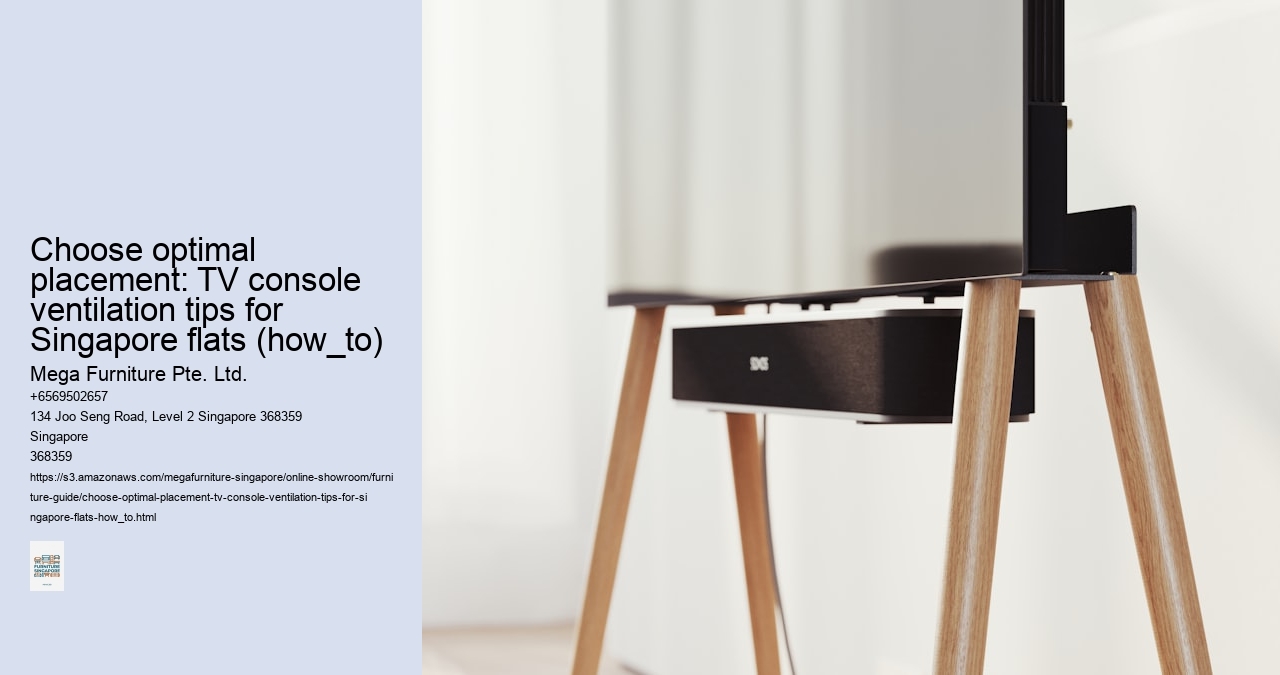
That solid, featureless back panel on a TV console might look clean, but it's a liability here. It traps all the heat from your PlayStation, AVR, and router against the wall—and in many HDB flats, that wall is solid concrete. Concrete doesn't just absorb sound; it soaks up that heat and radiates it back into the cabinet, creating a slow-cooker effect for your electronics. Combine that with our 80% humidity, and you've got a perfect recipe for component stress and shortened lifespans.
Ventilation isn't a luxury; it's a non-negotiable for any cabinet housing gear. The goal is to create a clear path for air to enter at the front or sides and exit out the back, preventing heat from stagnating. This is especially critical for larger setups built around 55-inch or bigger OLED TVs, where the consoles themselves are longer and can house more heat-generating equipment. A sealed box is a design flaw in our climate.
Look for specific physical features that facilitate this airflow. Rear cable grommets are a good start, but they're often too small. A perforated metal back panel is far more effective, allowing a broad area for heat to dissipate. Alternatively, consider a console designed to float 10 to 15 centimetres off the floor; this creates a natural convection channel behind and underneath the entire unit, pulling cooler air from the front and venting warm air upwards.
That floating design also solves another common problem: it prevents the entire back of the unit from being pressed flush against that heat-retaining concrete wall in your BTO or resale flat living room. It’s a clever two-in-one solution that manages cables and thermals. You can find consoles with these practical considerations in mind at Megafurniture's collection, where options range from wall-mounted to floor-standing with integrated ventilation.
Ultimately, the quiet hum of your electronics should be the only sign they're on. If your TV console is warm to the touch after a few hours, it's working against you, not with you. Prioritising these ventilation details from the start is cheaper than replacing a cooked graphics card or a router that keeps dropping signal.
That solid teak or oak console from a drier climate can swell and stick within a year in your Bedok flat. Engineered wood, especially MDF cores with thin veneers, is particularly vulnerable to Singapore's constant 80% humidity; the layers separate, edges bubble, and doors no longer close flush. You'll want either full solid wood, which moves more uniformly, or high-pressure laminates with fully sealed edges that lock moisture out. The latter often performs better across aircon on-off cycles, where temperature swings cause materials to expand and contract repeatedly. A quality laminate won't betray its engineered nature, offering a stable plinth for your 75-inch screen without seasonal drama.
Termites aren't just a landed property issue—they travel, and a TV console's dark, enclosed cavities offer a perfect feast. Powder-coated steel or aluminium legs elevate the carcass off the floor, creating a physical barrier that pests typically cannot bridge. This isn't merely a stylistic choice for a floating look; it's a pragmatic defence in neighbourhoods with older housing stock where infestations can migrate. Metal's inherent stability also means no warping, so your console's stance remains level even if the internal shelves experience minor movement. It’s a simple, effective concession to local realities.
Glass shelves lend visual lightness and are superb for displaying collectables, but they're a commitment to maintenance. In a typical 4-room BTO living room, dust mixes with airborne cooking oils, creating a persistent film that requires weekly wiping to stay clear. Tempered glass is non-negotiable for safety, yet its edges still show every fingerprint from handling game consoles or media players. Many buyers eventually find themselves using glass only for dedicated, static display zones, opting for easier materials on high-traffic shelves. It's a material that demands a certain type of household discipline.
Your console's top acts as a thermal shock absorber, sitting directly below an aircon blower that cycles between 19 and 30 degrees. Laminates with poor UV inhibitors will fade and chalk under the occasional afternoon sunbeam, while some veneers may develop micro-cracks over time. Sintered stone or quartz composite tops handle this best, but they come at a cost. A robust polyurethane or catalyzed varnish finish on solid wood is the more common solution, creating a resilient barrier against both condensation and light. This isn't just about spills; it's about material integrity across thousands of cooling cycles.
The right finish is a sealant, not just a colour. A matte or satin sheen is pragmatic, hiding fine scratches and dust far better than a high-gloss piano finish that shows every flaw. Look for factory-applied, multi-coat finishes that are baked on, as they provide a harder, more uniform seal than brush-applied onsite treatments. This sealed surface repels moisture from humid air and prevents staining from accidental drips, be it coffee or condensation from a cold drink. It’s the final, crucial layer that determines whether your console ages gracefully or starts to look tired before its time. For a wide range of options finished for local conditions, you can browse the TV console collection to compare.
A 240cm console wedged into a 12 sqm study-bedroom hybrid is a classic HDB miscalculation — it dominates the floor plan, leaving just centimetres for a study chair to scrape past, and turns what should be a multifunctional retreat into a single-purpose media cave. The mistake is visual before it’s practical; that sheer, monolithic length against a short wall makes the entire room feel like an afterthought, a corridor to the television. Proportion is everything in compact flats, and a console longer than a queen-size bed mattress rarely belongs anywhere but the living room.
Buyers then compound the error by positioning this oversized unit directly under the room’s only window, especially if it faces the Multi-Storey Car Park. That blocks the cross-ventilation many BTO blocks rely on, turning a potential breeze channel into a stagnant pocket. You’re trading natural cooling for a backlit screen glare, and the electronics inside the cabinet will generate their own heat, with nowhere for it to go.
Cable management is an afterthought in these scenarios, which guarantees visual chaos. A neat media wall in the living room can hide a spaghetti junction of HDMI and power cords behind panelling, but in a bedroom-study, those cables often trail across the floor to a single, distant power point. The result is a trip hazard and a persistent, dusty tangle that undermines any attempt at a clean, organised workspace. It’s a solvable problem, but it requires planning the console’s placement around your flat’s electrical layout, not just the wall it sits against.
The most frustrating oversight is failing to measure the journey, not just the destination. A console that fits perfectly in your plan might not fit through the 80cm doorway of your BTO bedroom, or, more critically, into the lift of your HDB block. Delivery crews in Tampines or Bedok estates frequently encounter this — they’re left manoeuvring a large, flat-packed box up multiple flights of stairs, which can incur extra charges or risk damage. Always confirm the narrowest point on the route from the lorry to its final position.
Some buyers focus solely on storage volume or aesthetic finish, like a sleek matte laminate, without considering these functional pitfalls. A slightly shorter console, perhaps around 180cm, from a collection that considers compact living, often delivers better utility without the spatial drama.
The difference between a TV console that lasts five years and one that lasts fifteen often isn't the price tag — it's the drawer glide you can't see online and the finish that photographs as solid walnut but feels like plastic laminate. A hands-on visit to Megafurniture's Joo Seng or Tampines showroom settles those questions immediately; you can assess the heft of a rubberwood frame, test the smooth, silent close of a full-extension drawer, and run a hand over a sintered stone top to judge its resistance to heat and moisture. That tactile verification matters because a 180cm console holding a 65-inch TV and a stack of AV gear endures constant use — a wobbly shelf or a sticky drawer becomes a daily nuisance. Ventilation is another feature that demands a physical check. Online listings might note "rear cable management," but that doesn't guarantee sufficient airflow for a PlayStation 5 or an AV receiver that gets hot. At the showroom, you can inspect the actual rear panels of display units like the Oslo or Haven models — are the cable ports just holes, or are they part of a larger mesh panel? You can feel the airflow space behind the unit and see how the internal layout manages heat from stacked equipment, which is critical for preserving electronics in our climate. Showroom staff offer advice grounded in local layouts, something generic online guides can't match. They’re familiar with the constraints of a 4-room BTO living room or the odd alcove in a Jalan Besar shophouse conversion; they can suggest the optimal console length to balance TV proportions with walking space, or recommend a floating design to make a narrow room feel larger. They also understand the bulk of international audio-visual equipment, advising on internal depth for a centre channel speaker or modifying a standard unit to accommodate unusually deep components. Ultimately, buying a TV console sight-unseen is a gamble on dimensions and daily function. A trip to the showroom — whether at Joo Seng near Aljunied or the larger Tampines outlet — turns speculation into certainty. You’ll leave knowing the exact shade of the oak veneer, the precise glide of the drawers, and whether the unit you liked online truly fits your space and gear.
Browse the TV console options online first, then go see them; your living room layout and your expensive electronics deserve that final confirmation.
A TV console arrives at your door in a flat-pack box the size of a small wardrobe — a daunting sight in a typical HDB lift lobby. That’s why confirming two-man delivery for walk-up apartments is non-negotiable; you don’t want to be the neighbour coordinating an impromptu, sweaty haul up three flights of stairs. Most major retailers, including Megafurniture, offer this as standard for non-lift access blocks, but it’s wise to verify when you book your slot. Schedule this for after your renovation dust has settled, too, because wood veneer and laminate are magnets for fine particulate, which can scratch surfaces during unwrapping.
Once inside, assembly typically takes 45 to 90 minutes for a straightforward floor-standing model. The real time-saver is checking what tools are included. Many sets now come with the single Allen key you’ll need, but for anything more complex — think wall-mounted or floating consoles with integrated cable management — you might need your own spirit level, electric drill, and stud finder. It’s a frustrating pause to realise mid-build that you have to pop down to the neighbourhood hardware store.
The industry-standard warranty is 12 months, covering manufacturing defects in materials and workmanship. Crucially, ask about coverage for humidity-related swelling, a common issue here that sometimes falls into a grey area. A robust warranty should acknowledge Singapore’s climate, protecting against drawers that jam or doors that warp under consistent 80% humidity, provided the unit hasn’t been placed directly against a wet wall or under an air-con drip. This isn’t just fine print; it’s practical assurance for a piece that will sit in your living room for years.
Plan the delivery for when your space is truly ready — after painting, flooring, and any major dust-generating work is complete. A console’s finish, especially in popular matte laminates or wood veneers, can be microscopically scoured by airborne renovation grit during installation. It’s a small scheduling detail that preserves the ‘new’ look far longer. You can browse a range of options designed for local spaces at Megafurniture’s collection, where specifications for delivery and warranty are clearly listed.
The most common TV console questions from HDB and condo owners aren't about colour schemes — they're about navigating the physical limitations of our flats. You'll find the same practical concerns popping up in renovation forums and family WhatsApp groups, each one a minor puzzle in the quest for a clean, functional media wall.
Can a console sit against a wet area wall, like the one backing a bathroom? It's a typical BTO layout dilemma. You can, but it's a calculated risk; the constant moisture exposure, even through tiles, will warp MDF or particle board within a few years. Opt for a console made from solid, treated rubberwood or a full metal frame with sealed doors — materials that can handle the ambient humidity without delaminating.
What about ventilation when the console backs a solid feature wall? That sleek, floor-to-ceiling laminate panel offers zero breathability. The workaround is to leave a mandatory 10cm air gap between the console's back panel and the wall itself, creating a channel for heat to rise and escape. It means sacrificing a few centimetres of floor space, but it's cheaper than replacing a cooked PlayStation.
For a PS5 tucked in a cabinet, you'll need more clearance than you think. Sony recommends 10cm on all sides, but in a closed cabinet during a Genshin Impact marathon, that's insufficient. Aim for 15cm minimum at the back and sides, and never enclose it in a drawer; use an open shelf or a cabinet with a perforated metal or woven cane door.
Rental-friendly cord management is its own art form. Adhesive-backed cable raceways from Sim Lim Tower are the go-to — they stick to skirting boards and console backs, can be painted over, and peel off without residue. For the final drop to the power point, a simple fabric cord cover zipped over the bundle looks intentional, almost like a design feature, and is completely reversible when your lease is up.
The last thing you want is a 200-centimetre console wedged against a 195-centimetre wall, leaving raw laminate edges exposed beside your feature paint. That final tape measure check is non-negotiable — confirm the exact wall length, then subtract at least 5cm for visual breathing room. Match the console’s width to your TV’s dimensions, too; a 65-inch screen looks precarious on a 140cm slab, while a massive 240cm unit can dwarf a modest 55-inch panel. Don’t forget to account for the depth of your deepest piece of equipment, typically an AV receiver or gaming console, which needs to sit comfortably inside without protruding past the cabinet’s front plane.
Ventilation is where many sleek designs fail in our humid climate. Open the showroom unit’s back panel and physically verify the cutouts align with your gear’s heat vents — manufacturers often skimp here, leaving a single small hole where you need three. Plan your cable routing before the cabinet arrives; decide where the router’s blinking lights will hide and whether a soundbar will sit on the console top or be wall-mounted just above it. A messy nest of HDMI and power cables not only looks terrible but also traps heat, creating a pocket of stale air that’s terrible for electronics.
For buyers coordinating with renovation timelines, stock availability is critical. If your contractor needs to install the console before the flooring crew arrives, you can’t wait eight weeks for a back-ordered item. Confirm with the retailer that your chosen model, in your specified finish, is physically in their local warehouse or showroom, ready for delivery. It’s a simple question that prevents weeks of living with a TV propped on a cardboard box.
Your final decision ultimately balances three competing demands: sufficient airflow for components, adequate concealed storage for routers and game libraries, and a living room footprint that doesn’t overwhelm a 4-room BTO layout. The perfect console grants enough internal height for a PlayStation to breathe, includes drawers for remote controls, and stops short of blocking your corridor to the kitchen. You can browse a range of options designed with these practicalities in mind at Megafurniture’s collection.
That 3.6-metre wall in a typical 4-room BTO flat isn't just a measurement; it's a hard constraint dictating your console length, your TV size, and the entire room's balance. A TV console anchors the wall opposite the sofa in the same way a tall bookshelf anchors a corner — long horizontal piece, mix of open and closed storage, defines the visual weight of one whole side of the room. Megafurniture's TV Console range covers floating wall-mounted designs, low-profile freestanding consoles, and modular feature-wall configurations. Most pieces sit at 40-50cm height, sized for screens up to 75 inches.. You'll find console lengths are commonly built to match these standard dimensions - a 3.6m or 4.2m unit will leave the precise, minimal gaps that make a built-in look work. A Bookshelf earns its place in Singapore homes through dual function — book and decor storage in the open shelves, soft visual division when placed mid-room in open-plan condominium layouts. Megafurniture's combined display unit and bookshelf hub covers tall book racks, cubby-hole designs, ladder shelves, modular cube systems, and glass-door pieces in oak, walnut, and MDF veneer finishes. Solid-wood pieces typically start around $425, with most heights spanning 120cm to 220cm to fit standard 2.6m HDB ceilings.. Go longer, and it crowds the adjacent doors; go shorter, and the setup looks stranded, leaving awkward dead space at each end that collects clutter.
Condo layouts introduce different challenges, particularly with media walls or projector screens. A floor-standing console for a 75-inch TV might need to be shallower to avoid jutting into a narrow walkway, while a floating design can preserve a sense of floor space beneath a wall-mounted screen. The key is avoiding overhangs in resale corridors, where every centimetre of width is precious for moving furniture or squeezing past during family gatherings.
For landed homes, scaling proportionally is the real test. Display cabinets sit between bookshelf and storage cabinet in function — closed glass-front protection for the items you want visible but not collecting dust. Megafurniture's Storage Cabinet range covers glass-front, curio, wall-mounted, and freestanding configurations in solid wood, MDF, and metal-framed constructions. Average pricing for glass-front variants sits around $271, with LED-lit and motorised-shelf models commanding the higher tier.. A high ceiling and a large-format 85-inch screen demand a console with substantial visual weight and length - a 2.4-metre unit in solid rubberwood or with a sintered stone top can anchor the space without looking lost. It's less about fitting a wall and more about creating a balanced focal point; the console here often becomes a serious piece of furniture in its own right, with deep storage for AV equipment that would overwhelm a flat.
Material choices follow these spatial rules. In a humid, enclosed HDB layout, a perforated metal back panel on a console isn't just a design detail - it's a necessary vent for that amplifier or gaming console you've tucked inside. A solid timber back in the same spot is a recipe for overheated electronics.
Ultimately, the right console length solves the puzzle before you even think about style. You can explore proportions and finishes that suit your space in Megafurniture's collection, which is organised around these common Singapore room dimensions.
That 3.6-metre wall in a typical 4-room BTO flat isn’t just a measurement; it’s a hard constraint dictating your console length, your TV size, and the entire room’s balance. You’ll find console lengths are commonly built to match these standard dimensions — a 3.6m or 4.2m unit will leave the precise, minimal gaps that make a built-in look work. Go longer, and it crowds the adjacent doors; go shorter, and the setup looks stranded, leaving awkward dead space at each end that collects clutter.
Condo layouts introduce different challenges, particularly with media walls or projector screens. A floor-standing console for a 75-inch TV might need to be shallower to avoid jutting into a narrow walkway, while a floating design can preserve a sense of floor space beneath a wall-mounted screen. The key is avoiding overhangs in resale corridors, where every centimetre of width is precious for moving furniture or squeezing past during family gatherings.
For landed homes, scaling proportionally is the real test. A high ceiling and a large-format 85-inch screen demand a console with substantial visual weight and length — a 2.4-metre unit in solid rubberwood or with a sintered stone top can anchor the space without looking lost. It’s less about fitting a wall and more about creating a balanced focal point; the console here often becomes a serious piece of furniture in its own right, with deep storage for AV equipment that would overwhelm a flat.
Material choices follow these spatial rules. In a humid, enclosed HDB layout, a perforated metal back panel on a console isn’t just a design detail — it’s a necessary vent for that amplifier or gaming console you’ve tucked inside. A solid timber back in the same spot is a recipe for overheated electronics.
Ultimately, the right console length solves the puzzle before you even think about style. You can explore proportions and finishes that suit your space in Megafurniture’s collection, which is organised around these common Singapore room dimensions.